RB+EVA · Sole Systems
Rubber where the ground is. Cushioning where the foot is.
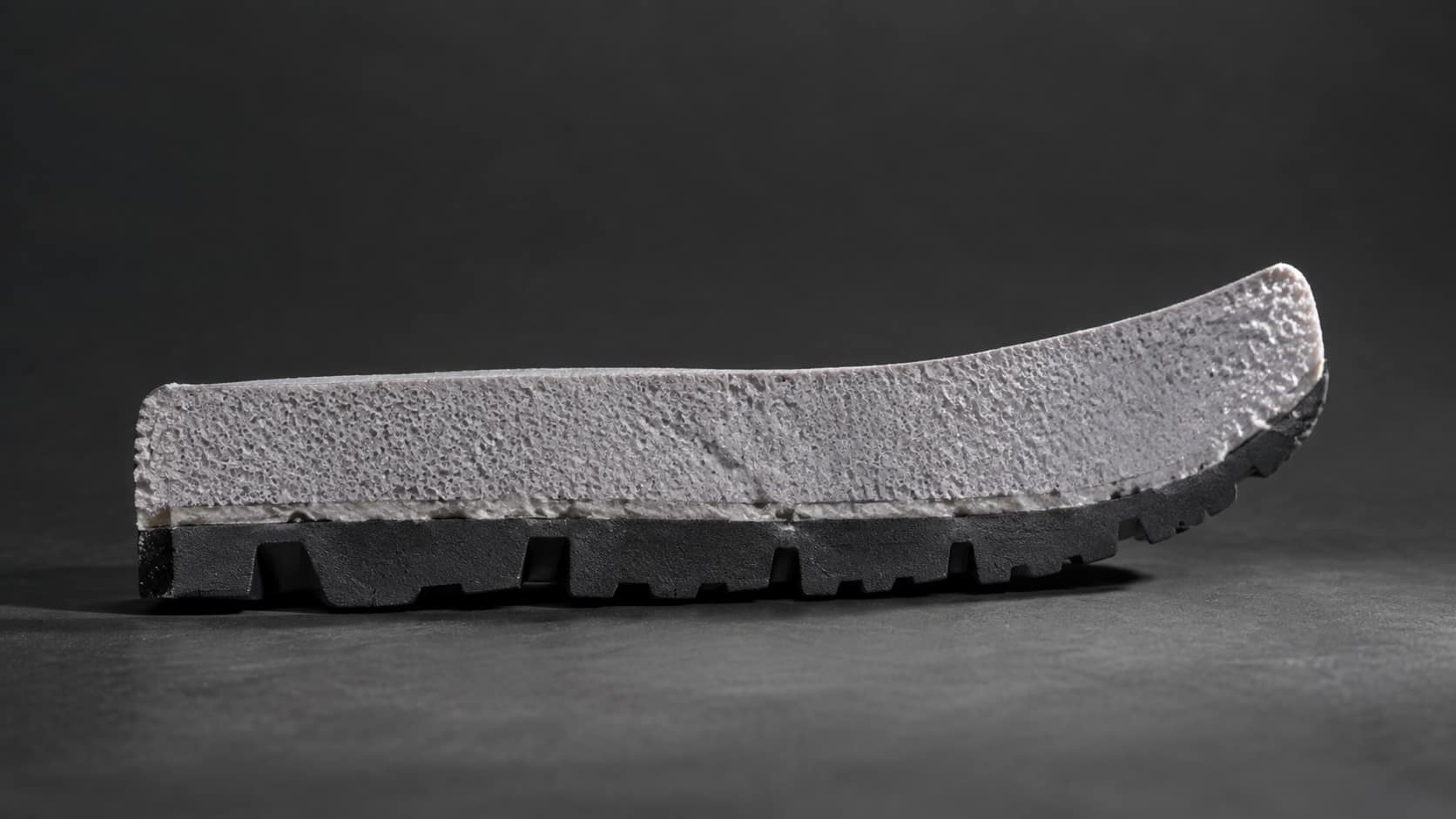
The combination sole puts a vulcanised rubber outsole under an EVA midsole: abrasion resistance below, cushioning above, two densities engineered as one part.
What it is
A rubber EVA combination sole separates the two jobs a sole has to do. The rubber outsole takes the abrasion, the cut growth and the wet grip. The EVA midsole above it takes the impact. Each material is specified where it works best, instead of one compound compromising both.
The critical detail is the bond line. Peel strength at that interface decides whether the sole survives its first winter, so it is tested as a first-class property, not inspected after failure.
Specification envelope
Where a row is marked held in production it is our own window, measured on the compounds we run. The rest describes the family. Values for your specific compound and construction come with the full spec sheet; request it below.
| Outsole hardness | Held in production: 60–65 Shore A rubber |
|---|---|
| Midsole hardness | Held in production: 40–45 Shore C EVA sole stock for sport and running |
| Midsole density | Held in production: 0.20 g/cm³ |
| Colour | Contrasting or matched outsole / midsole colours |
Tested against
The standards buyers most often write into the specification for this family. In-house rigs run on site; items marked external are booked with an accredited laboratory. Full rig-to-standard mapping is on the quality page.
Where this sole is specified
| Segment | What drives the spec | Tests that gate it |
|---|---|---|
| Running & Athletic | Cushioning under the forefoot, rubber only where the shoe wears | Abrasion ISO 4649 · flex ISO 17707 · outsole-midsole peel SATRA TM404 |
| Work & Safety | Slip, heat and fuel-oil exposure; long wear life on hard floors | EN ISO 20345:2022 (slip now mandatory, SR marks the enhanced test) · HRO · FO |
Hardness and density
These are windows Hongsole holds in production, not the range the material category can reach. Rubber and TPR are quoted in Shore A, EVA in Shore C. A spec sheet that mixes the two scales is worth a second look. Why the two do not convert.
| Application | Hardness | Density |
|---|---|---|
| EVA midsole, sport / running | 40–45 Shore C | 0.20 g/cm³ |
Two tools and two processes: steel for the rubber outsole, aluminium for the EVA midsole, then the bond. That is more tooling than a single-material sole, and it buys the ability to change one layer without recutting the other. That is a real advantage when a midsole density is still being tuned after the outsole is signed off.
How this sole fails, and what sees it coming
Every construction has characteristic failures. A supplier who names them is more use than one who implies there are none, and each of these is caught by a rig on the quality page rather than by an apology afterwards. Acceptance limits are yours to set; what follows is what to look for and when it is cheapest to look.
This construction has an interface, and an interface is something that can open. It is a preparation and adhesive discipline rather than a material one — surface contamination and cure conditions decide it. Outsole-to-midsole peel, SATRA TM404 and TM411, is the test that gates it, and we book it externally rather than claim it in-house.
The rubber layer wears slowly and the EVA midsole compresses, so the sole that fails is usually the half nobody tested. Compression set on the midsole density, checked after conditioning, is the reading that predicts how the shoe feels a season in rather than on the day it ships.
EVA sole stock yellows on ageing and under light, and it does so on the layer a buyer sees from the side of the shoe. On a white or pastel programme this is checked on aged samples rather than only at sign-off, because the sole that was approved and the sole in a shop window are months apart.
When to specify something else
Our own figures, not a category benchmark. Held across the six sole systems; a programme that moves them says so in the quotation. Full terms, tooling cost and mould ownership are on the OEM & ODM page.
The other five systems
Compression-moulded rubber outsoles built for abrasion resistance and grip. Custom tread geometry from your drawing or sample.
Foamed rubber that keeps the wear characteristics of solid rubber while cutting unit weight for all-day comfort.
Thermoplastic rubber soles with fast tooling turnaround and clean colour reproduction. Regrind-friendly process.
The combination sole moulded as a single unit. No bond line to delaminate, fewer assembly steps downstream.
Injection-moulded phylon for tight dimensional tolerance and repeatable output at volume. Dedicated IP tooling in-house.
Weighing one material against another? EVA, rubber and TPR compared runs the properties side by side.
Questions buyers ask about this
What stops a combination sole delaminating?
Peel strength at the bond line, which we treat as a first-class property rather than something inspected after a failure. Outsole-to-midsole peel goes to an accredited external laboratory against SATRA TM404 and TM411, and the report comes back per programme. If delamination is a warranty concern, the one-piece moulded sole removes the interface entirely.
What EVA midsole hardness do you hold?
40–45 Shore C at 0.20 g/cm³ for sport and running midsoles. EVA is quoted in Shore C and the rubber outsole above it in Shore A. The two scales are not interchangeable, and a spec sheet that mixes them is worth a second look.
Can the outsole and midsole be revised independently?
Yes, and it is the main practical advantage of the bonded construction over a one-piece sole. The rubber runs in steel tooling and the EVA in aluminium, so a midsole density can still be tuned after the outsole geometry is signed off without recutting the outsole tool.
Need the rubber / eva combination soles spec sheet?
Send the drawing, the sample or just the shoe it has to survive. We come back with compound, hardness range, MOQ and timing for your programme.