A02 · Applications
The standard changed. Most supplier sites have not.
EN ISO 20345:2022 withdrew the SRA, SRB and SRC markings and made basic slip resistance mandatory for all safety footwear. If a sole supplier is still advertising an SRC rating, they are quoting a scheme that no longer exists.
What this segment demands
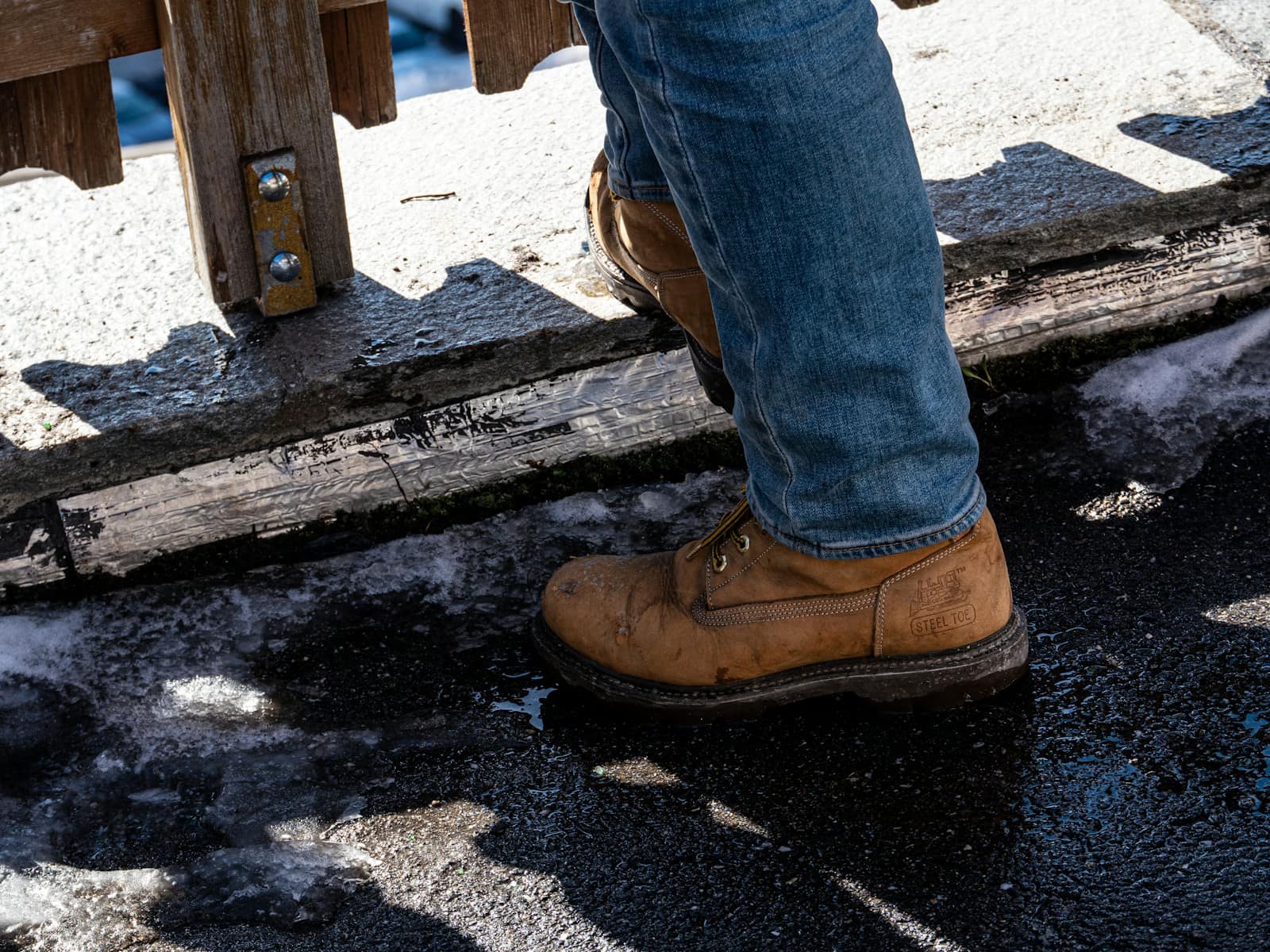
Safety footwear is the segment where the specification is written by a standard rather than by a brand, and that changes what a sole supplier has to be able to demonstrate. The 2022 revision of EN ISO 20345 folded basic slip resistance into the base requirement for every piece of safety footwear, and reserved the `SR` marking for the enhanced test. The old SRA / SRB / SRC ladder is gone. Confirmed against uvex, Shoes For Crews and Parade — and still quoted, verbatim, across a good part of the supplier web.
The practical consequence for a sole is that slip performance is no longer an option you specify on top; it is the floor. What you specify on top is which additional properties the boot is certified for: HRO for contact heat on the outsole, FO for fuel-oil resistance, and the conditioning protocol behind each. Those choices drive the compound, and the compound drives what the tooling has to do, which is why they belong at the DFM review and not at the sample stage.
Wear life is the other half. A safety outsole spends its service life on concrete and steel decking rather than on trail, so abrasion loss on a hard flat surface is a better predictor than lug performance on soft ground. We hold a harder compound for this segment than for lifestyle work for exactly that reason, and the two rows are published separately below rather than averaged into one band.
Which sole system, and why
More than one family will do the job. What separates them for this segment is below; the full specification envelope for each is on its own page.
The segment default. Vulcanised rubber is the only family here that takes the heat and fuel-oil requirements without a separate discussion, and it holds a deep lug through a long service life.
Where the boot is worn standing all day rather than walking. A foamed midsole under a rubber outsole cuts the weight and the fatigue without giving up the wear surface.
Hardness we hold for this segment
Windows measured on the compounds we run, not the range the material category can reach. Rubber, foamed rubber and TPR are quoted in Shore A; EVA soles and midsoles in Shore C. Why the two do not convert.
| Application | Hardness | Density |
|---|---|---|
| Rubber outsole, safety / work | 65–70 Shore A | 1.15 g/cm³ |
What gates the specification
The tests that decide whether a sole for this segment passes. Eight rigs run on site; the full rig-to-standard mapping and what goes to an external laboratory is on the quality page.
| Footwear slip resistance | SATRA TM144, ISO 13287 or ASTM F2913 on our slip resistance tester. Mandatory under EN ISO 20345:2022 rather than optional; `SR` marks the enhanced test. |
|---|---|
| Abrasion resistance | ISO 4649 method A. The predictive figure for this segment is loss on a hard flat surface, which is what the DIN tester measures. |
| Contact heat (HRO) and fuel oil (FO) | Compound-level decisions taken before tooling. Where the certification body wants a witnessed test we book it with an accredited laboratory and it comes back as a report. |
| Thermal ageing and low temperature | Constant-temperature chamber, conditioned to your protocol. There is no single common standard here, so the protocol has to come from you or from the certification body. |
Where this stops being ours
- We make the sole, not the certificate. EN ISO 20345 certifies a finished boot, and the certification is held by whoever assembles it — we supply the outsole and the test data that supports its part of the file.
- Penetration-resistant midplates, toe caps and antistatic assemblies are shoe-build components. They sit above the sole and are not ours.
- Electrical-hazard and ESD footwear needs conductivity held to a measured window through the whole sole stack. We do not currently publish one, so treat that as a conversation rather than a capability.
What we need to quote this
Beyond the standard checklist: the exact standard and marking you are certifying to, whether HRO or FO is in scope, and the certification body if one is already appointed. Their protocol usually decides the compound before we do.
The standard checklist, and the six stages a programme runs through, are on the development page.
Our own figures, not a category benchmark. Held across the six sole systems; a programme that moves them says so in the quotation. Full terms, tooling cost and mould ownership are on the OEM & ODM page.
Other footwear segments
Building for work & safety?
Send the drawing, the sample or the standard you certify to. We come back with the sole system, a compound and hardness recommendation, and a tooling plan.