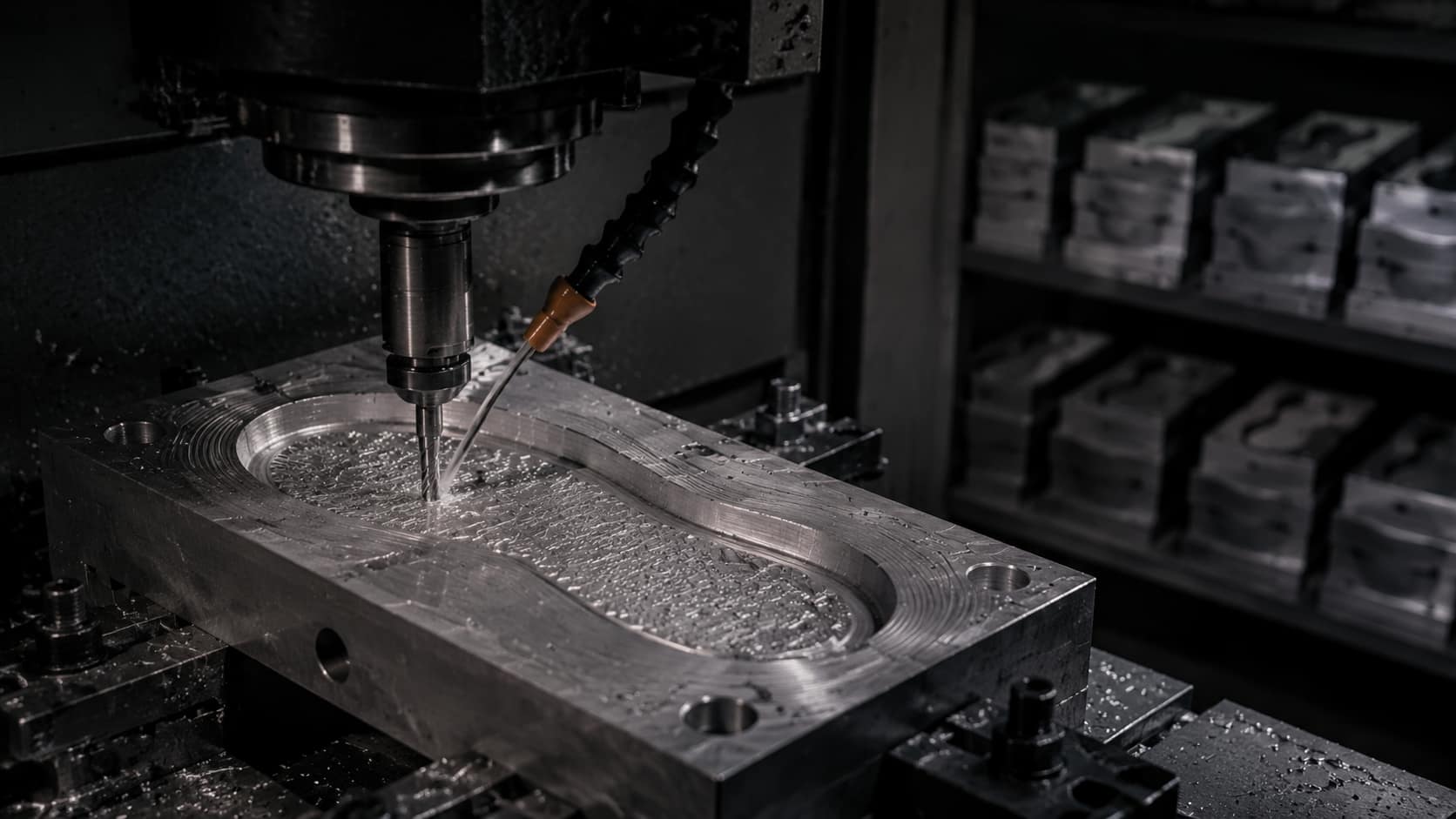
Mould Manufacturing
The mould shop is ours.
Hongsole grew out of a tooling business founded in 1997, and the mould plant is still the centre of the group. Wood carving through CNC, roughly 500 sole moulds a month, in a dedicated 4,000 m² site.
From wood carving to finished sole.
Four production routes, each with its own line. A programme can move between them without leaving the group.

Mould Making
Wood carving → CNC machining → trial shot

Rubber (RB)
Compound prep → moulding → trimming → finishing

EVA
Pelletising → foam processing → foam moulding → forming

IP Injection
Material prep → injection → demould → inspection
What owning the tooling actually buys you.
Four things that change when the mould shop is not a subcontractor.
A tread revision is a production decision
When the mould shop belongs to someone else, every change to a lug depth or a sidewall becomes a purchase order, a queue and a margin. Ours is down the road, so revisions move at the speed of the engineering, not the paperwork. A sample mould is cut and trialled without leaving the group: prototyping happens in-house, at production pace.
Tooling is quoted per size, not per style
A full size run means a dozen moulds or more. Factories that quote "per style" are quoting one size and will invoice the rest later. Ask for the mould count with the price, from us or from anyone else.
Steel for rubber, aluminium for EVA soles
Rubber needs the thermal mass and durability of steel under repeated cure cycles. An EVA sole runs in aluminium, which heats and releases faster. A supplier that offers one material for everything is telling you something.
Ownership is settled before we cut
Who owns the tool, where it is stored, and what happens if you move production, agreed in writing up front. It is the term overseas brands most often discover too late.
Budgeting a programme?What a set of outsole moulds really costs: industry reference ranges →
Questions buyers ask about this
How many sole moulds can you produce a month?
Roughly 500, from a dedicated 4,000 m² tooling plant running wood carving through CNC machining. Because the mould shop is ours, a tread revision is scheduled on our own floor rather than queued behind another customer at an outside mould vendor.
Do you cut moulds in steel or aluminium?
Rubber normally runs in steel and EVA in aluminium. Steel holds edge definition through the long cure a rubber compound needs; aluminium is cheaper to cut and entirely adequate for EVA and TPR cycles. A combination sole uses both.
Why is tooling priced per size rather than per style?
Because a mould is cut to one size. A graded size run therefore needs a dozen or more moulds, which is why complete tooling for a shoe programme can reach five figures even when the per-mould figure looks modest. Send the size span with your enquiry; it drives the tooling quotation more than the sole design does.
Have a tread you want cut?
Send the drawing or the sample shoe. We come back with the mould count for your size run, the tooling material and the price per mould.