Resources · Quotation
What to send for an outsole quote.
A quote is only as exact as the brief behind it. Here is what an outsole factory needs to price a custom sole, what each item changes on the number, and what to send instead when you do not have it yet.
Published
A quote is a model of your sole.
An outsole price is built from four things: how much compound goes into each pair, which moulds have to be cut, how long each pair spends in the press, and how many pairs share those costs. Every line of a request for quotation settles one of them. The lines you leave out do not disappear. The factory fills them with an assumption, and assumptions are why three factories quote the same shoe three different ways.
None of this means you need a finished specification before you ask. Each item below says what to send, what it changes on the price, and what to send instead if you do not have it yet.
Ten items, and what each one prices.
In rough order of how much they move the number. The first five decide the tooling; the rest decide the unit price.
| Item | What to send | What it fixes | If you do not have it yet |
|---|---|---|---|
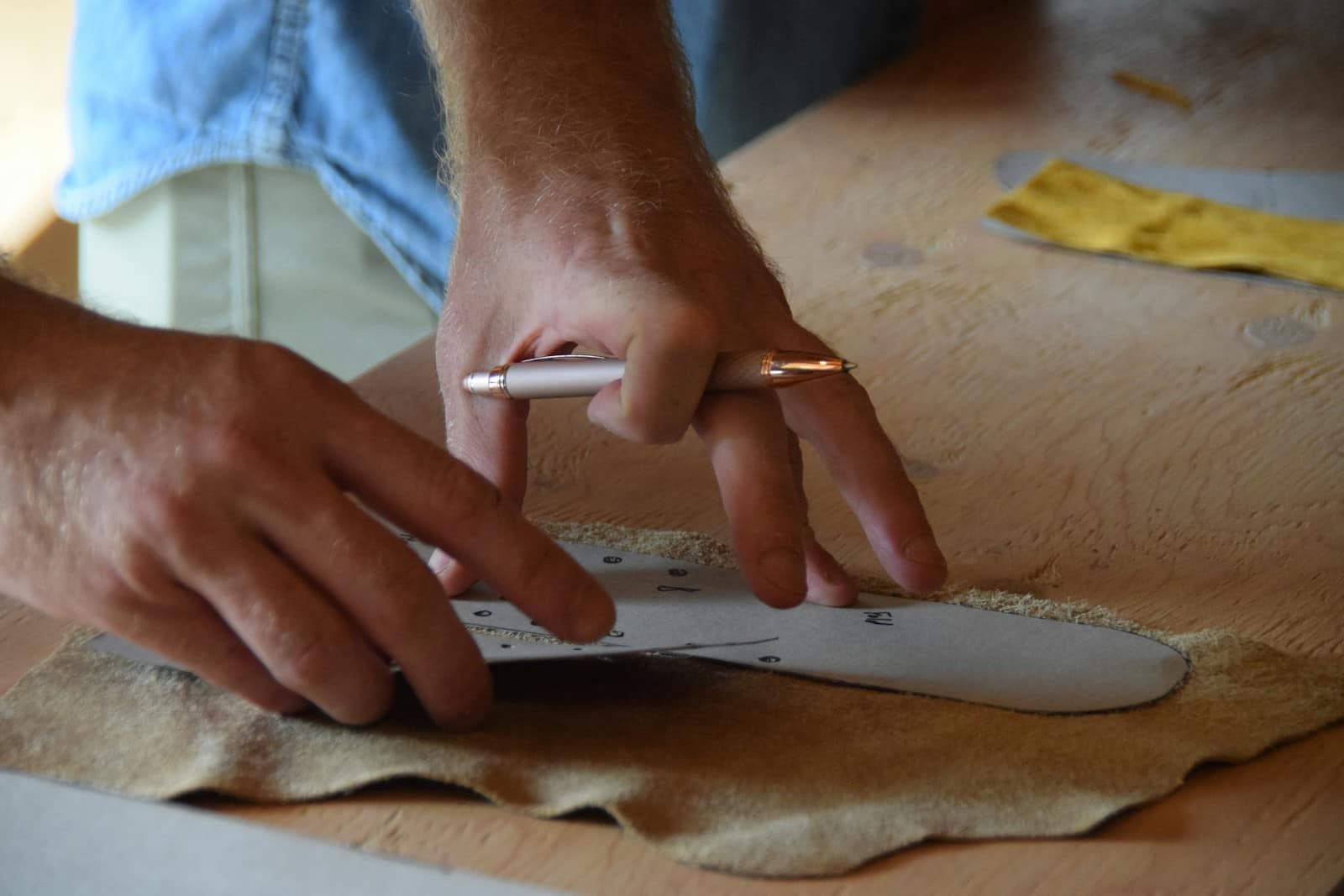
| Reference geometry | A drawing (AI, STP, IGES, DWG), a 3D scan, or the sole itself in the post. | The volume of compound in every pair and the shape of every mould: the two largest inputs to the price. | Photos of the sole from below and from the side with a ruler in frame, and the size written down. Enough to discuss construction, not enough to price tooling. |
| Sole construction | Which of the six systems, or a reference shoe that uses it. | The process, the press and the tooling metal: steel for rubber, aluminium for an EVA sole. | Describe the shoe and where it is worn. Recommending the construction is part of our reply. |
| Hardness, with its scale | Shore A for rubber and TPR, Shore C for an EVA sole or midsole. | The compound. A number without its scale cannot be quoted against. | Send a reference sole whose feel you want and we read it on the durometer. |
| Target weight | Grams per sole at one named size. | The density, and whether the geometry has to lose volume to get there. | Weigh the sole you are replacing on a kitchen scale and send the figure with its size. |
| Size range and grading | The full span in EU, UK or US sizing, with half sizes if you run them. | The mould count. Tooling is priced per size, so this line moves the tooling bill more than any other. | Say who wears it: adult men’s, women’s, or a children’s run, and for which market. |
| Colours | How many, then Pantone references or physical chips. | The minimum order, which is set per colour because every colour is its own compound batch. | The count is enough at first. References can follow before sampling. |
| Logo and markings | Artwork, and where it sits: tread, heel or sidewall. | The engraving in the mould. A moulded logo is cut into the tool, so changing it afterwards means recutting. | Say whether there will be one and where. Artwork can follow, but it must arrive before tooling is cut. |
| Volume | The first order and the annual expectation, per colour. | The unit price, and how many pairs share the tooling. | An honest range. A quote built on an inflated volume prices an order you will not place. |
| Where it is worn | The worst surface the shoe meets, the temperature range, and any standard the finished shoe certifies to. | The compound, the tread and the test plan. | Describe the wearer and the conditions. That is enough to choose a compound; the standard can follow. |
| Timeline and target price | The date you need finished goods, and the price you are aiming for. | Which trade-offs we propose. A target price tells the factory where to take cost out; without one it can only quote the drawing. | Optional. Leave it out and you get the price of the brief as written. |
Weight is volume times density.
Buyers ask for a sole in grams. A factory holds it in grams per cubic centimetre. The weight of a sole is its volume multiplied by the density of the compound, so a weight target is really two decisions: which density, and how much volume the geometry needs.
The material decides more than the geometry. On the densities we hold in production, the same moulded volume weighs about 4.6 times as much in solid rubber as in a casual EVA sole, and 2.9 times as much as in foamed rubber. Thinning a wall or opening a cavity moves the weight by a fraction of that.
Weight is quoted per size, because the volume grows through the size run. Send the weight you are aiming for at one named size, and the weight of the sole you are replacing if there is one.
| Held in production | Density | Hardness |
|---|---|---|
| Rubber outsole, casual / lifestyle | 1.15 g/cm³ | 60–65 Shore A |
| Rubber outsole, safety / work | 1.15 g/cm³ | 65–70 Shore A |
| Foamed rubber outsole | 0.40 g/cm³ | 60–65 Shore A |
| TPR outsole | 1.00 g/cm³ | 60–65 Shore A |
| EVA sole, casual / slipper | 0.25 g/cm³ | 55–60 Shore C |
| EVA midsole, sport / running | 0.20 g/cm³ | 40–45 Shore C |
Say where it is worn, not that it must not slip.
“Anti-slip” cannot be quoted or tested. Slip resistance is measured on the whole shoe, to SATRA TM144 or ISO 13287: a coefficient of friction on a defined surface with a defined contaminant, so the tread is measured along with the compound. A brief that names the surface (wet tiles, wet pavement, packed snow), the temperature range and whether the finished shoe needs a certificate gives us something to design to and something to test against.
The compound and the tread do different jobs. The tread decides whether water or snow is cleared from under the sole. The compound decides whether the sole stays in contact once it is cold: every sole compound stiffens as the temperature drops, some much sooner than others, and TPR is the one we flag for losing grip and flexibility in the cold. For a winter programme, ask for cold conditioning before the slip and flex tests, so the numbers you sign off are the ones the shoe will have in January. The rigs and the standards they run to are on the quality page.
A complete brief gets a complete quote.
The unit price per pair, the mould count with the price per mould, the tooling metal, and these terms.
Our own figures, not a category benchmark. Held across the six sole systems; a programme that moves them says so in the quotation. Full terms, tooling cost and mould ownership are on the OEM & ODM page.
If you are starting with less.
A new brand rarely has a drawing on day one. Three things are enough to start: a reference shoe or sole, the size range, and an honest first-order volume. Everything else in the table can be settled in the replies that follow.
State the real volume even if it is small. On existing tooling our minimum is 1,000 pairs per colour; on new tooling it is 2,000 pairs per style, 1,000 per colour. The same arithmetic rules out a single pair or a replacement sole for a shoe you already own: the tooling alone would outweigh the order many times over, at any mould-based factory.
A blank brief.
Paste it into an email, fill in what you know, and leave the rest blank. A blank line is an honest answer; a guess is not.
Sole construction:
Reference:            drawing / 3D file / sample posted on ____
Hardness:             ___ Shore A (rubber, TPR)   ___ Shore C (EVA sole)
Target weight:        ___ g per sole at size ___
Size range:           ___ to ___  (EU / UK / US)
Colours:              ___  (Pantone or chip)
Logo / markings:      tread / heel / sidewall
First order:          ___ pairs per colour
Annual volume:        ___ pairs
Worn on:              surface, temperature range
Tests / standard:
Finished goods by:
Target price:         per pair
Going deeper on any line.
Hardness scales and the two mistakes we see most often in an RFQ are in theShore hardness guide. What a size run of tooling should cost, and where quotes hide the per-size moulds, is in theoutsole mould cost guide. Choosing between the materials is theEVA vs rubber vs TPR guide, and what happens after the quote is thedevelopment sequence.
Send the brief, or as much of it as you have.
Fill in what you can and attach the drawing or photos to an email, or post the sole. An engineer replies within one business day.